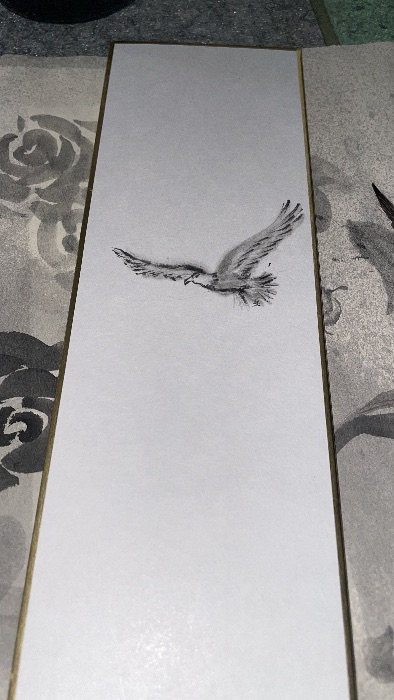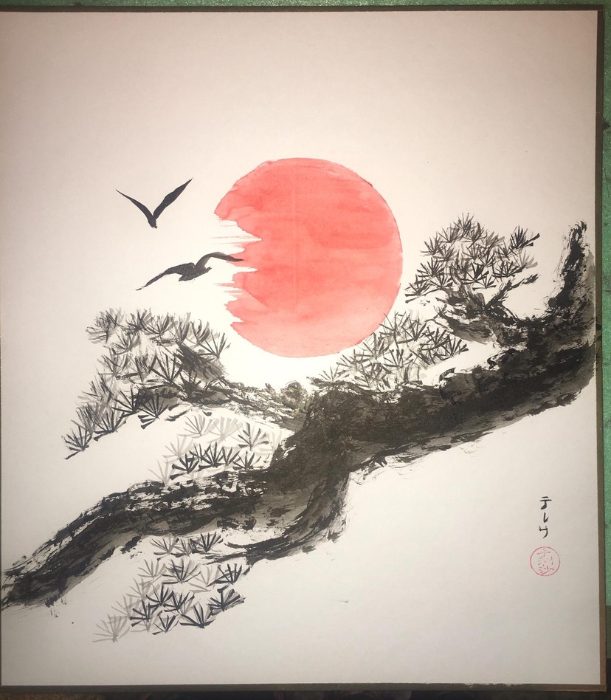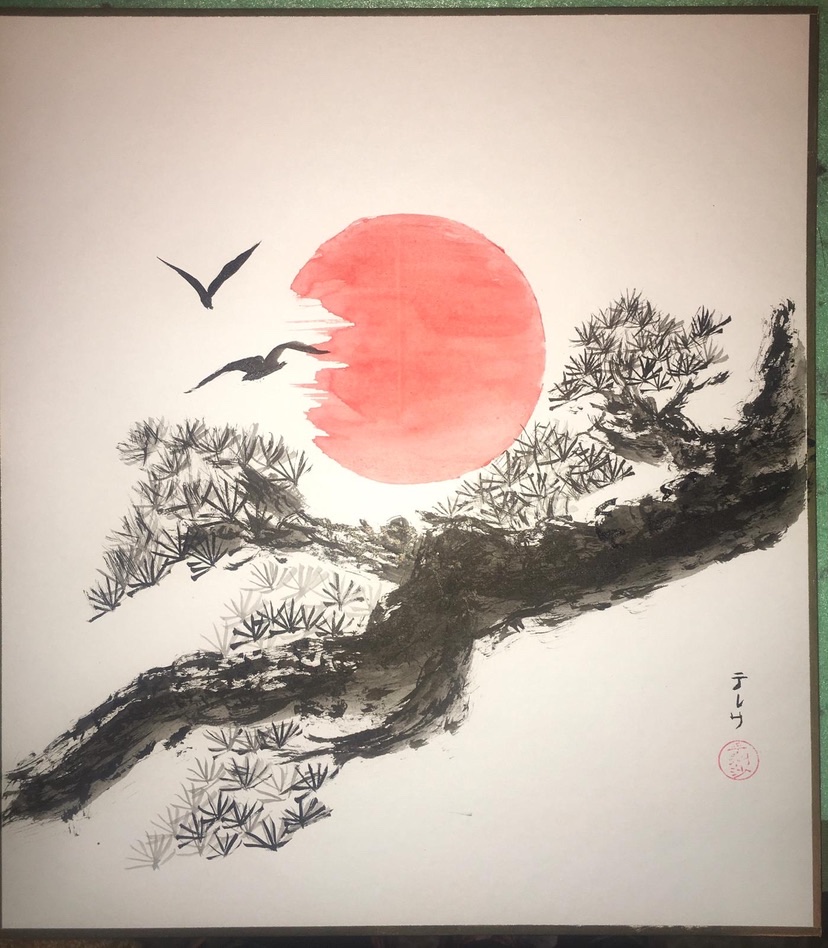
If you have seen a Japanese painting on a square, rigid board with a thin gold edge, you have seen a shikishi (色紙). It is one of the best-loved supports for sumi-e painting and calligraphy, and it is perfect for anyone who wants to bring an original, small-format Japanese work into their home.
What a shikishi is
A shikishi is a rigid board, made of several layers, with a paper surface suited to ink and often a gold edge. The most common size is about 24 × 27 cm, slightly taller than it is wide.
Originally, in ancient Japan, shikishi were decorated sheets on which poets wrote their compositions. Over time they became the ideal support for short poems, calligraphy and small paintings.
Why it is special for sumi-e
- It is rigid: it does not need to be mounted on a scroll or a canvas.
- It is ready to display: you rest it on a stand or frame it without complicated preparation.
- Its size is intimate: it invites you to paint a single subject, with a lot of empty space around it. Just as the spirit of sumi-e wants.
Our Red sun and old pine, for example, is painted on shikishi.
How to display it
On a stand (shikishi-kake)
In Japan shikishi are often displayed on a small table stand or in a special hanging frame called a *shikishi-kake*, into which the board slides and can easily be changed. It is the traditional way to change the painting with the seasons.
In a frame
If you prefer to hang it on the wall, choose:
- a simple frame, in natural or black wood;
- a light mount, which lets the painting breathe;
- anti-reflective glass, if the wall gets a lot of light.
Next to a suiseki
Shikishi and suiseki are natural companions: the painting suggests the season and the atmosphere, the stone brings the landscape. A mountain stone beside a painted red sun, or an island stone near birds in flight, create a small complete scene. Read How to display a suiseki for more ideas.
How to look after it
- Keep it away from direct sunlight: strong light can, over time, yellow the paper and fade the colours.
- Avoid damp rooms (bathrooms, cellars).
- If you store it, keep it flat, in a paper envelope.
Shikishi, kakejiku and other supports
Besides the shikishi, sumi-e is also painted on rice paper or washi (handmade Japanese paper), which can then be framed or mounted on a kakejiku, the vertical hanging scroll. In the description of each of our paintings you will always find the support and the way it is delivered.