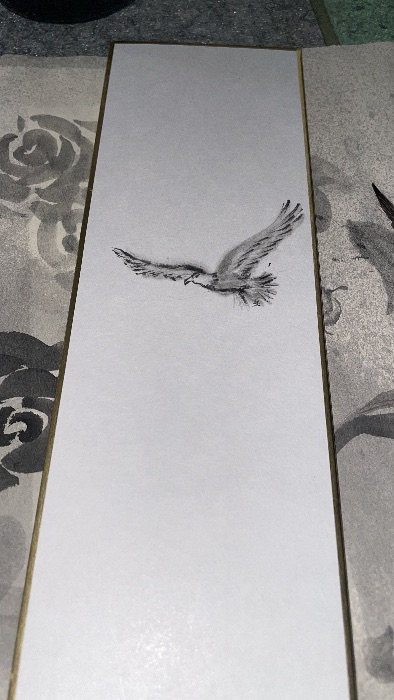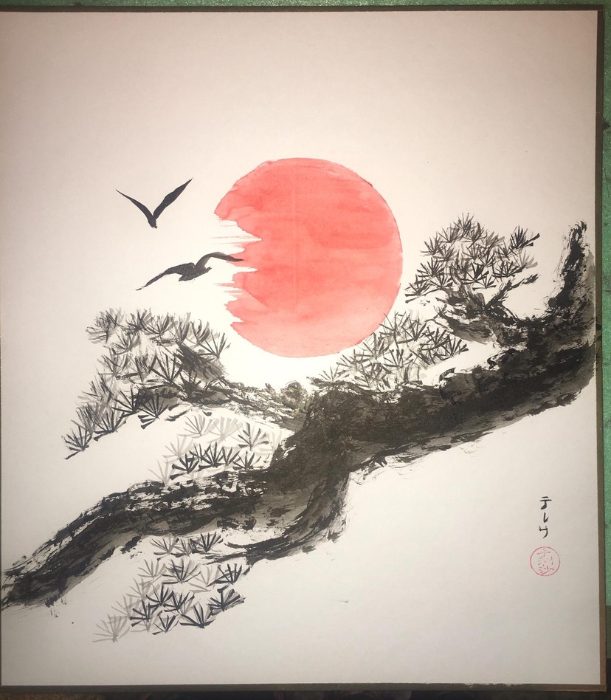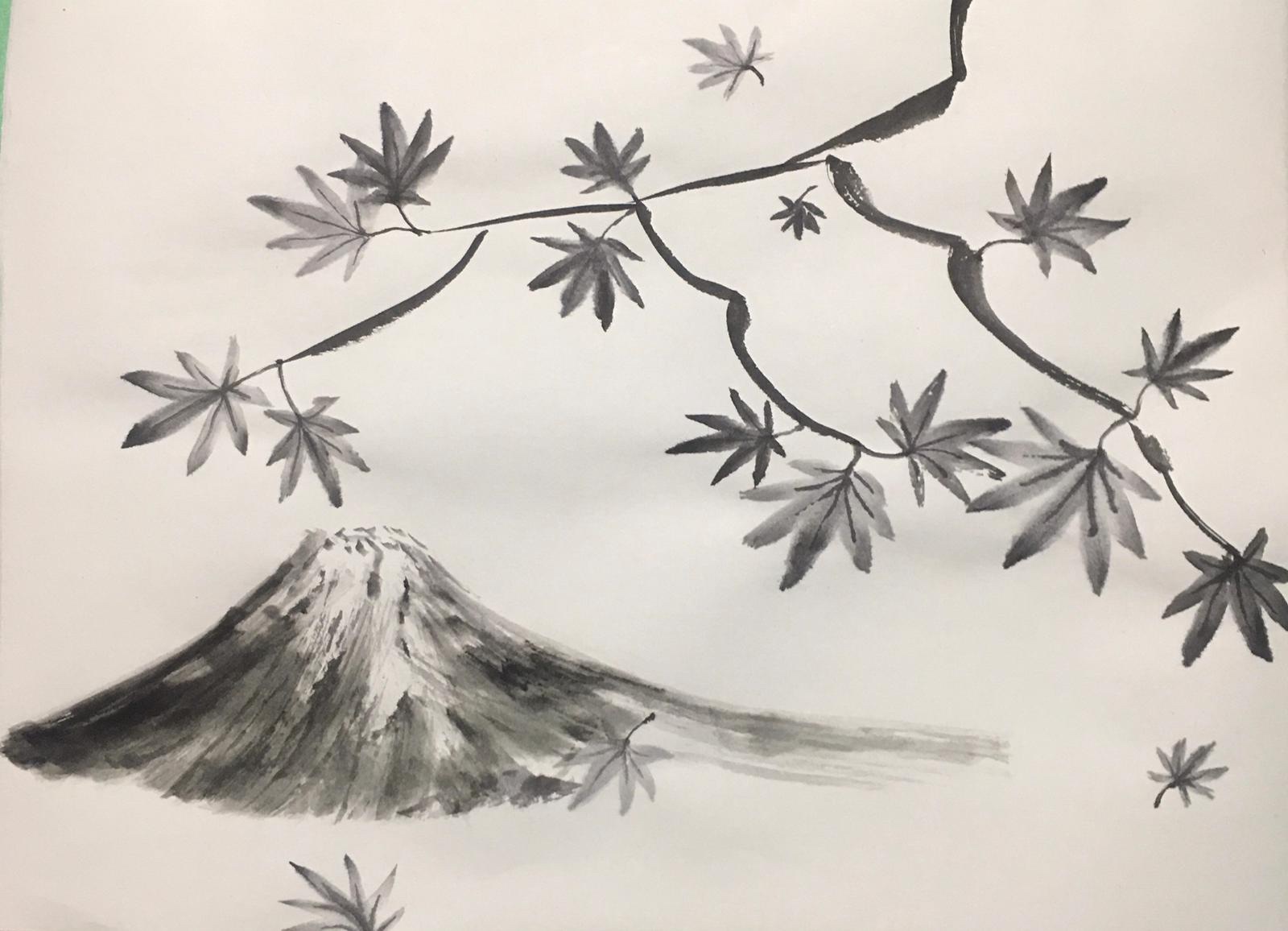
A pine branch in a few brushstrokes. A mountain emerging from the mist, made almost entirely of white paper. A circle drawn in a single gesture. This is sumi-e (墨絵), literally "ink painting": the Japanese art of painting with black ink and water.
An art of subtraction
Western painting often adds: layers of colour, details, shadows. Sumi-e does the opposite: it takes away. The aim is not to copy reality but to capture its essence with as few brushstrokes as possible.
That is why in sumi-e empty space matters as much as the mark. The white paper becomes sky, mist, water, snow. The Japanese call this meaningful space *ma*.
The tools: the "four treasures"
The sumi-e painter works with four tools, traditionally called the four treasures of the study:
- The brush (*fude*), with a bamboo handle and a tip of natural hair, able to make a very fine line and, a moment later, a broad wash.
- The ink (*sumi*), a solid stick made of soot and glue, rubbed with a little water.
- The inkstone (*suzuri*), on which the stick is ground. The more you grind, the darker and denser the ink.
- The paper (*washi* or rice paper), thin and absorbent, which forgives nothing: every drop leaves a mark.
Preparing the ink by grinding it on the stone takes a few minutes: time painters use to calm the mind before painting.
A gesture that cannot be corrected
Sumi-e paper absorbs the ink instantly. You cannot erase, you cannot go over a stroke again: every brushstroke is final. That is why the painter practises the same subjects for years and then, when painting, does so with a quick, confident gesture.
It is also why every sumi-e painting is one of a kind: the same painter, painting the same subject, will never produce two identical works.
The link with Zen
Sumi-e came to Japan from China together with Zen Buddhist monks, who practised it as a form of meditation. Concentration, simplicity, acceptance of imperfection: the values of Zen are the same as those of sumi-e. We tell its story in The history of sumi-e.
Only black? Not always
Classic sumi-e is monochrome, but black ink actually contains endless shades of grey, from the most intense to the most transparent, depending on how much water you use. Many painters add a single touch of colour: the red of a sun, the pink of plum blossoms. In our paintings you will find both versions: ink only, or ink with watercolour.
The classic subjects
Bamboo, orchids, plum blossoms, chrysanthemums, pines, mountains, birds, the moon. Each subject has a meaning and a precise technique. The four most important ones even have a special name: you will find them in The four gentlemen of sumi-e.
Signature and seal
A sumi-e painting ends with the painter's signature and seal (*hanko*), usually in red. The seal is not a detail: it is part of the composition, balances the space and guarantees authenticity. In Teresa's paintings you will find her name in Japanese, テレサ, and her seal.
How to look at a sumi-e
Calmly, from a little distance, letting your eye fill the empty spaces. Do not look for details: look for the movement of the brush, the speed, the breath. A good sumi-e does not show everything: it invites you to complete it.