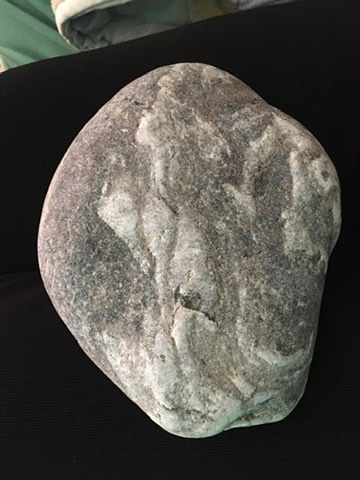
In the world of suiseki people often say that the daiza is half the work. A stone, however beautiful, set down on a table remains one object among many. The same pebble, resting on a stand carved especially for it, suddenly becomes a suspended landscape, to be looked at in silence.
What a daiza is
The daiza (台座) is a small wooden stand, carved by hand to fit a single stone. Its upper part follows the exact shape of the base of the pebble, so that the stone fits into it without moving and seems to "grow" out of the wood.
A well-made daiza is not noticed at first: it guides the eye towards the stone, it does not steal it.
What it is for
- Stability. Many stones cannot stand on their own in their most beautiful position. The daiza holds them at the right angle.
- The point of view. Every suiseki has an ideal front and tilt. The daiza fixes them for good.
- The frame. Like the frame of a painting, the daiza separates the work from the space around it.
- Protection. It stops the stone from scratching furniture, and furniture from scratching the stone.
How a daiza is made
Making a daiza is slow work that requires patience and precision. Here, in short, are the steps Teresa follows in our workshop:
- Studying the stone. Looking for the best front and tilt, sometimes for days.
- Tracing the outline of the base of the stone on a block of wood.
- Hollowing out the seat that will hold the stone, trying again and again until the pebble fits perfectly, without gaps.
- Shaping the outside: the edges, the thickness, and the small feet that lift the daiza and make it look light.
- Finishing and darkening the wood, so that it does not distract from the colours of the stone.
The result is an object that exists for a single stone in the world: that is why a daiza, like its suiseki, is one of a kind.
Which wood is used
Hard, stable woods are preferred, which can be carved precisely and do not warp over time. The colour is usually darkened, to harmonise with the stones, which tradition prefers in deep tones.
Daiza, suiban or nothing?
Not every stone wants a daiza. Stones that recall islands or rocks, for example, look wonderful in a suiban, a low ceramic tray with fine sand or water. Some collectors, instead, prefer to buy a stone without a stand and have one made.
In our shop we always state how the stone is presented: with a daiza hand-carved by Teresa, on a suiban, or without a stand. If a stone you like does not yet have its daiza, write to us: we can talk about it.
Care tips
- Dust the daiza and the stone with a soft brush or a dry cloth.
- Keep the suiseki away from direct sunlight and heat sources, which can dry out the wood.
- From time to time you can apply a thin layer of neutral wax to the daiza to nourish the wood.
Want to see a daiza up close? Every suiseki in our shop has photos from several sides: discover the suiseki. And if you are wondering how to display a stone at home, continue with How to display a suiseki.