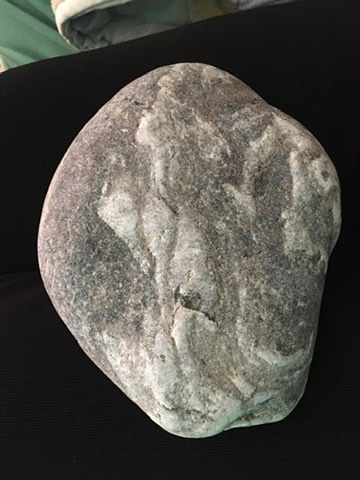
One of the most fascinating things about suiseki is giving a name to what you see in a stone. Over the centuries Japanese enthusiasts developed a precise vocabulary, still used today at exhibitions all over the world. Knowing it helps you "read" a stone and display it the right way.
In general stones are classified according to three criteria: shape (which landscape or figure it evokes), the pattern on the surface and colour.
Landscape stones
These are the most classic. The stone recalls an element of the natural landscape.
Yamagata-ishi: the mountain stone
A stone with one or more clearly recognisable peaks. If the peak is central and dominant it recalls a nearby mountain; if the peaks are gentler and in a line, the stone is called tōyama-ishi, "distant mountain", and suggests a mountain range seen from afar.
Dan-seki: the terraced plateau
Stones with flat surfaces arranged in steps, like a plateau or a terraced hill.
Taki-ishi: the waterfall stone
A light vein, often of quartz, runs down the dark stone and recalls falling water. They are among the most sought-after stones, because a convincing "waterfall" is rare.
Mizutamari-ishi: the water pool
Stones with a natural hollow that can hold water, like a little mountain lake.
Shimagata-ishi: the island stone
They recall an island or a rock rising from the sea. They are often displayed in a suiban, the tray with sand or water, to strengthen the illusion.
Dōseki: the hut stone
Stones that recall a shelter, a mountain hut or a cave: they evoke a place to stop and rest.
Figure stones
Sugata-ishi
The stone recalls a figure: a person, a seated monk, a deity.
Dōbutsu-seki
It recalls an animal: a bird, a turtle, a fish, a sleeping cat. These stones make people smile and often win over even those who know nothing about suiseki.
Pattern stones: mon-ishi
Here the surface counts more than the shape. Veins and inclusions draw flowers, moons, rain, mist. Among the most famous are chrysanthemum stones, with a natural "flower" set in the rock. Our Stone of mists also belongs to this family: the light veins on its dark surface recall mist rising between mountains.
Colour stones: iro-ishi
Stones that stand out above all for their colour, rare or especially intense.
Abstract stones: chūshō-seki
Not every stone looks like something precise. Some are simply beautiful: a harmonious shape, a balance, a tension. These are abstract stones, appreciated above all by the most experienced collectors, because they require a free eye.
How to choose the right category
In front of a stone, try asking yourself these questions:
- What do I see first? A peak? An island? A figure? That is probably the category.
- From which side is it most beautiful? Every suiseki has a "front": the side from which the landscape reads best.
- How would I display it? Mountains look good on a daiza; islands in a suiban.
There is no wrong answer: classification is a tool for looking better, not a cage. And if a stone moves you without resembling anything, perhaps it is an abstract stone.
Want to know more about presentation? Read The daiza: the stand that completes a suiseki, or discover the available suiseki.