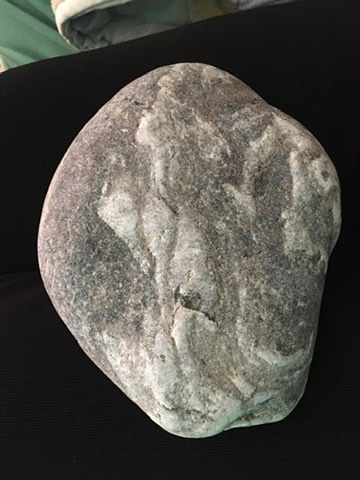
Imagine picking up a pebble on a riverbank and seeing in it a distant mountain, wrapped in mist. This, in a few words, is the experience of suiseki: the Japanese art of finding, choosing and contemplating natural stones that evoke a landscape or a form of nature.
What the word means
*Suiseki* (水石) is made of two characters: sui, "water", and seki, "stone". Water is present twice: because it is the water of rivers and the sea that, over thousands of years, has shaped the stone; and because, traditionally, stones were often displayed in a tray of water or sand, like little islands.
The golden rules of a suiseki
Not every beautiful pebble is a suiseki. Enthusiasts all over the world share a few principles:
- The stone is natural. It is not carved, cut on its visible part or polished. Its shape is the work of nature, not of people.
- It evokes something. A mountain, a waterfall, an island, a shelter, an animal, or a natural pattern on its surface.
- It is hard and compact. The most prized stones are tough, with a surface that ages well and darkens over time.
- The colours are sober. Tradition prefers dark, deep tones that convey calm.
- It is small enough to hold in your hand or place on a piece of furniture. A suiseki is contemplated up close.
How a suiseki is presented
A stone on its own, set down on a table, is "just" a stone. To become a suiseki it needs a presentation that isolates it and brings it to life:
- The daiza: a wooden stand carved to fit, following every curve of the base of the stone. It is the most common way to present one. We talk about it in The daiza: the stand that completes a suiseki.
- The suiban: a shallow ceramic tray filled with sand or water. Ideal for stones that recall islands or rocks.
- The doban: a bronze tray, older and more precious.
Types of suiseki
Suiseki are classified by what they recall: there are mountain stones (*yamagata-ishi*), waterfall stones (*taki-ishi*), island stones, hut stones, stones that recall figures or animals, and stones that stand out for the pattern or colour of their surface. You will find them all, explained one by one, in Types of suiseki.
Why contemplate a stone
For someone discovering it for the first time, suiseki can seem a strange art. In fact it is an exercise in attention: it invites you to slow down, to look for a long time, to use your imagination. In a ten-centimetre stone you can "travel" as in a real landscape. It is the same spirit as Zen gardens and the tea ceremony: little material, a lot of room for the mind.
It is no coincidence that suiseki grew up closely tied to Buddhist culture and to circles of scholars, and that it is still often displayed alongside bonsai. We tell the story of its origins in The history of suiseki.
Italian suiseki: is that possible?
Absolutely. The tradition was born in Japan, where some rivers are famous for their stones, but the rules of suiseki apply wherever water polishes rock. In Italy there are associations, exhibitions and passionate collectors (we talk about them in Suiseki in Italy).
Our stones come from the sea and rivers of Calabria. Teresa looks for them on foot, one by one, and carves a daiza by hand for each of them. You can see them on the page of our suiseki.
In short
- A suiseki is a natural, unworked stone that evokes a landscape or a figure.
- It is presented on a wooden daiza or in a suiban.
- It is contemplated calmly, using the imagination.
- Every suiseki is, by definition, one of a kind.